Saturday, May 29, 2021

The Straight and Narrow Path After Entering the Gate

     I've long been fascinated with the concept of having one's calling and election made sure. It seemed to me to be a great way to get a little mental rest, knowing that I've "made it". As the matter of fact, I remember praying for the Lord to set me on a journey toward my calling and election at one point in my life. It must have been a righteous desire because it worked! Everything around me seemed to fall apart very quickly, and all at once. 

    It soon occurred to me that if I were to prove that I would serve the Lord "at all hazards" I would have to go through an awful lot of hazards. That seemed to be the opposite of mental rest. Lesson learned. Still, the longing haunts me. But as much as I desire to get to that point someday, I'm content to take a line upon line approach for now. Slow and steady wins the race, right? 


    Fortunately, the Lord seems to be very anxious to tell us exactly how to do it since we can find lists and examples all throughout the scriptures and other gospel resources. In 2 Peter 1:5-7, we are given a formula for becoming what Peter called the partakers of the divine nature. Peter explains that by obtaining this gift we "shall never fall" (2 Peter 1:10).

    Something I have found fascinating is that the list provided by Peter reflects the Beatitudes given by Christ himself on the Sermon on the Mount (Matt. 5) and in the Americas (3 Nephi 12). This gives me assurance that there is a specific path and order to follow to become as Christ is and receive the promise of eternal life. 

    The first attribute that Peter teaches that we need to give "all diligence" to is faith (2 Peter 1:5). Christ's first beatitude is "Blessed are the poor in spirit who come unto me..." (3 Nephi 12:3). When all else fails and we are at our lowest points in life, Satan will tempt us to give in, give up, or get angry. It is a tremendous act of faith to, instead, kneel in prayer when there is not a single whisper of hope left in you.


    Peter then teaches that to that faith we need to add virtue (2 Peter 1:5). The Latin origin of virtue is virtus meaning valor or moral perfection. Since we know that we can only be made perfect through the atonement of Christ which requires us to repent and be washed clean, it makes sense that Christ also mentioned this process as his second step. "Blessed are they who mourn, for they shall be comforted" (3 Nephi 12: 4). Through repentance, our sins are forgiven and we are simultaneously comforted and become more virtuous. This part is discussed through two different lenses, but the process is the same.

    Similar comparisons can be made for knowledge (2 Peter 1:5) and hungering and thirsting after righteousness (3 Nephi 12:6); temperance (2 Peter 1:6) and meekness (3 Nephi 12:5); brotherly kindness (2 Peter 1: 7) and mercy (3 Nephi 12:7); and on down the list. 


    Another similar list can be found in the church's 12 step program. When the 12 steps are studied carefully, they reveal themselves as the same process through yet another lens. From humbly recognizing your need for God (poor in spirit), right down to embodying and sharing the message of peace and hope in Christ to others (peacemaker).

   Many of God's prophets started out in opposition to Christ and were still able to receive this divine promise. Alma the Younger and Paul were notable examples. Others had ambiguous beginnings like Enos. This gives me hope that even I, as imperfect as I am, can reach this level someday. 


    Of course, there were others who were exemplary from the beginning like Nephi and the brother of Jared. The point is that the mysteries of how to receive this gift have been openly revealed for those who seek it. This is important because the last days (our days) will be marked by saints so righteous that they cannot be influenced by Satan (1 Nephi 22:26). From all appearances, the Lord, through Peter, is teaching us how this needs to be done because there will come a day when we will need that level of protection (2 Peter 1:4, 10). 

Friday, May 21, 2021

Be Not Deceived

         Have you noticed that the admonitions of Paul to the leaders and followers of his day reads like a playbook for the last days? I would think that Satan would have to think of some new ideas but his old ones seem to work very well. So, I guess he figures, "If it ain't broke..."

        If you haven't gotten into the latter part of the New Testament lately, let me share some admonitions that Paul gives members in his day. Then we can take a look at why he's teaching these things and see if we would benefit from applying his counsel in our day.

     Greek Philosophers


        In a letter to Titus, a committed church leader and follower of Jesus Christ, Paul warns about priestcrafts, or as he puts it, teaching things which they ought not, for filthy lucre's sake (Titus 1:11). This was a stumbling block to some in the church. In his day, Greek philosophers were all the rage and Paul had to constantly remind the church not to follow after these evil men. One of these philosophers even admitted that they were all evil beasts and liars (Titus 1:12).  Paul called them "vain talkers" and "deceivers" (Titus 1:10). In other words, they loved to debate and hear themselves talk. But for all their 'intellectual pontification' they never seemed to get anywhere useful. These men were paid to raise questions and confuse doctrines but didn't offer any Godly edification through faith (1Timothy 1:4).


Motivational Speakers 


    Ok, Anthony Robbins is a bit of a dinosaur these days, but his teachings are still around. He wasn't the first man to practice priestcraft in our generation, but he is arguably the most popular. Today, his estimated worth is over $600 million, and while I don't have a problem with the fact that he is successful, I wonder if anyone can point to something truly edifying that he has provided to the world. Most of his rhetoric revolves around how to get money, status, "the good life", not how to serve and be saved. To me, he is one of the most prolific "vain janglers" (Titus 1:6) of our time.

         Political Commentators


       So, what do you think? Are these workers of priestcraft? They all certainly became wealthy, or wealthier, from professionally debating, lying (stretching the truth?), and telling people what they want to hear without offering anything of edification or faith. What about Facebook, Instagram, Youtube, TikTok, etc. Do these fit Paul's definition of " "vain talkers" and "deceivers" (Titus 1:10).


        Just as in Paul's day, Satan seeks to divide and confuse us. But Paul gives us specific counsel about what to do about it. We should pray for all men including our leaders in government so that we can live in peace (1 Timothy 2:1-2). We must search the scriptures for inspiration, doctrine, and reproof (2 Timothy 3:16) and not look to worldly philosophies. We should also look to God's anointed servants for truth, and pray in faith. (1 Timothy 2:7-8). And we should pray in faith for a remission of our sins, even those done ignorance as Paul did (1 Timothy 1:13-16).

Saturday, May 15, 2021

His Grace is Sufficient, and...


His Grace is Sufficient, and...

            Recently, I came across an article that reminded me of President Nelson's recent conference talk entitled, Christ is Risen; Faith in Him Will Move Mountains. Something he said stirred up a bit of controversy, but I took his words to heart and tried to learn what the message was for me. He said, 
        
"My dear brothers and sisters, my call to you this Easter morning is to start today to increase your faith. Through your faith, Jesus Christ will increase your ability to move the mountains in your life, even though your personal challenges may loom as large as Mount Everest.
Your mountains may be loneliness, doubt, illness, or other personal problems. Your mountains will vary, and yet the answer to each of your challenges is to increase your faith. That takes work. Lazy learners and lax disciples will always struggle to muster even a particle of faith. To do anything well requires effort. Becoming a true disciple of Jesus Christ is no exception."


    It's the last part I would like to focus on. In Ephesians 2:8, it reads, "For by grace are ye saved through faith; and that not of yourselves: it is the gift of God." As I've been studying and pondering this week, I've come to the conclusion that many members of the church misunderstand this verse. One reason, I believe, is because it's taken out of context. We must remember that this was what was told to those who were struggling to give up the Law of Moses. They believed that obedience to the Law of Moses was the basis for salvation. They needed to be taught that Christ is their Savior and that they needed to look to Him, not rituals. 

    In contrast, our dispensation has gone nearly 180 degrees the other way. While we still look to some rituals to define our level of spirituality, we are equally in danger of leaving Christ out of our salvation equation. Too many of us, myself included, have put nearly all the responsibility of our salvation on him. We think, 'his grace will save me, plus I have a little extra insurance because I hold a temple recommend.' Maybe that's true, and maybe it's more complicated than that. I honestly don't really know. 


    But, again, we can look to Paul for some insight. In Romans 12: 1-2, Paul makes it clear that we are to present our bodies as a living sacrifice and we must be transformed by renewing our minds. This doesn't sound as easy as promising to pay your tithing and showing up to "do your calling". It's also telling that Paul's view of presenting our bodies as a holy, living sacrifice is our "reasonable service". It's like he's saying, 'It's the least you can do.' But I don't think he's specifically talking about a healthy diet or being chaste, although that would certainly be part of it. I think what he's saying is that we need to maintain holiness in our bodies through all of our words and actions. 

    As far as our minds go, this task won't be any easier. Verse two talks about not conforming to this world, but being transformed. This is not only allowing us to be good people, it's the only way we can do the will of God. We can only truly do His will if we have His mind. This is made clear in Romans 10:2-4 when Paul explains that it isn't enough to think you are a good person. You have to know the mind and will of God or your "zeal" doesn't mean anything. 

    Well, all of this seems very overwhelming for sure. Just be perfect and don't let the world influence your thoughts. But this is where we get to apply Christ's grace. In Philippians 4:13, Paul teaches, "I can do all things through Christ which strengtheneth me." And Paul would know. Paul suffered a lot of strange things and always seemed to come out ok. In Acts 27:3 he was bitten by a snake (viper). Those who were with him were convinced that he must be evil to deserve a snake bite and that it was to make up for the fact that he dodged fate by surviving the boat wreckage. Paul merely shook the snake off of his hand into the fire and went about his business.

    Paul was put through a lengthy process of trying to be set free due to false charges. He pled with the Jews, King Agrippa, and Ceasar to set him free because he had done nothing wrong (Acts 25:10). He kept getting bounced around, bound up, accused. etc. So many things could have gone wrong, yet he was eventually freed. I'm not trying to say that Paul had an easy life. He certainly didn't, but through the trials that would have broken any other man without Christ, Christ's power was demonstrated over and over again through Paul's trials.


    Having a perfect understanding of these principles, Paul declared, 

"Yea doubtless, and I count all things but loss for the excellency of the knowledge of Christ Jesus my Lord: for whom I have suffered the loss of all things, and do count them but dung, that I may win Christ" (Phillippians 3:8)

    Paul, like so many apostles and disciples before him, sacrificed everything for Christ. It makes me wonder why so many of us believe that we can sit idly and assume our mansion is being built in heaven just because we belong to Christ's church. How are we different than the Pharisees?

    I think what I'm coming to understand about Jesus Christ is that His grace is sufficient, and ...we need to qualify for it if we want to take full advantage of it. We are not saved by works, but we qualify for grace when we truly and honestly turn our hearts to Him and try to become like him. What's so amazing is that we can qualify for this enabling power now, while we are still on Earth. But, like Paul, we must begin by always remembering what President Nelson said, "To do anything well takes effort. Becoming a true disciple of Jesus Christ is no exception".


Friday, April 23, 2021

The Sanctification of Suffering


 I've been thinking a lot about suffering lately. I've wondered what the real purpose of suffering is and what role it plays in the Great Plan of Happiness? If suffering were bad, Christ wouldn't have done it, nor would he ever inflict us with it. There must be something purposeful, even holy, about suffering. And if that's true, what blessings are we denying ourselves by trying to avoid it at all costs?

    Peter and John were thrust into prison and beaten for teaching and healing in the name of Jesus Christ. Upon their release, they were warned never to speak of Jesus again. They didn't murmur or curse the council for what the council had done. Acts 5:41 says, "And they departed from the presence of the council, rejoicing that they were counted worthy to suffer shame for his name." Then, they went right back to preaching and healing!

This is my goal!

                                                                       Image by: Brf, Wikimedia Commons


This is my training program!


 It's funny because it's true, right?

       In the pictures above, I make fun of how common it is for us to be so unwilling to endure anything difficult. Even if the difficult thing is merely to deny ourselves pleasurable things. We spend so much time justifying our need to "indulge" once in a while, or to practice "self-care" that many of us have made ourselves soft. We concern ourselves with getting our fair share or fighting for what we think we have a right to. All in the name of getting even more comfortable than we already are. But what if we've got it all wrong? 


                                       Image by: ChurchofJesusChrist.org

     Christ suffered so his little brothers and sisters could live again, become purified, and come back home. That kind of suffering, suffering for a purpose bigger than yourself, is a holy offering beyond any other kind of suffering or sacrifice. The blessings gained from that kind of sacrifice are too numerous to contemplate. But receiving personal blessings wasn’t why he did it. He did it for love. There was value in the suffering itself. His suffering blessed others, and for him that was enough reason to do it. I hope to be like that one day.


     But how often do we pray to be as Christ is without having to go through anything he went through? Maybe I'm just speaking for myself, but I often focus on how sinless he was and strive to be like that. Usually without asking for his help. Or I think I should align my will with God (as long as it doesn't interrupt my personal ambitions). It’s funny how articulating it makes it obvious how silly it is. It doesn't seem that I'm going about this the right way.


    I've begun to wonder what I’m willing to suffer to actually be like Christ. Not just a façade of what I think he’s like. I imagine a loving healer and peacemaker who was revered by many. But am I also willing to be an outcast in his name? Am I willing to be despised, ridiculed, and mocked? Am I as willing to die for truth as he and his disciples were, I mean actually be put to death in the most horrifying way possible? Am I willing to do all that? If I'm not, then how can I ever truly be like him? Because that was his life. That's what his heart was really made of. He taught the gospel and healed the broken and broken-hearted no matter how angry people got or how tired he became. No matter how many lies were told about him. No matter who turned their back on him. Can I really pray to him and say, "Make me like you, but not with "that" calling or not with "that" ministering companion?" "Make me like you, but punish those who betray me. Don't ever let my friends abandon me on my hardest days. And please, don't make me give up food for a whole 24 hours!" 


    Can you see how completely pathetic we must sound to him? And yet, he always answers with love and patience; another skill I have yet to master. How do I even hope to become someone like that? Where do I begin? The answer, I suppose, is somewhere, I mean, literally anywhere. I just need to begin. And maybe the best place to start is exactly where he tells me.


"Learn of me, and listen to my words; walk in the meekness of my spirit"

(Doctrine and Covenants 19:23). 

Friday, December 13, 2019

Growing Old Together, Gracefully

What do you think about when you hear the words "retirement" or "empty nest"? If you're like most young people, you probably haven't given it much thought up until now. It seems so far away, and with a family to raise, who has time to worry about it? But let's take a moment, though, shall we?

For young people with children, an empty nest or retirement may seem like a long-awaited reward for a life well-lived. I hope this is true for all of us, but like most things, it has to be intentional to work out the way we hope. Of course, staying physically fit and healthy as well as preparing financially for later years is important for full enjoyment. (By the way, did you know that Social Security only provides enough to allow you to live merely a few dollars above the poverty line? Scary but true.) There are a lot of things worthy of consideration and planning before the end of the working family phase is done. But, aside from the practical aspects, other aspects need to be planned for as well.

Why being an Empty Nester is Harder on the Single Parent
After decades of having her life revolve around her children, empty nesting is hardest on the woman. The desire to nurture doesn't disappear just because she's sent all her children out into the world. Depression and feelings of worthlessness can easily set in.

Serving her husband or neighbors is just not the same as nurturing a child into adulthood. She could try, but adults are a bit more likely to resent a woman reminding them to eat their vegetables and put on a coat.

Similarly, when a man stops going to work every day to provide for the family, his sense of self-worth can really take a hit. He is likely very proud of the work he has done in all those previous years. He has just as likely invested much of his identity into being a good husband and father based on his work identity. What defines him now?

Occasionally, life-changing events will occur before her children are gone and before he cracks one last groan-worthy joke at his retirement party. These need equal attention, regardless of when they may occur. 

The middle-aged couple may find themselves caring for elderly parents while they still have children of their own at home. They may begin losing peers to premature death. It's not just sad to lose friends, but a person's own mortality becomes very real and very scary when those their age pass away. Declining health is another trial that nearly all adults will face at some point. With increasing healthcare costs, it's wise to have some money set aside for all those medications you'll likely need.

So, it isn't all that hard to imagine why depression after life-altering events is not uncommon. Fortunately, this type of melancholy is usually temporary as aging adults adjust to a new normal. But, just because something is common, doesn't mean that the degree of the effects can't be mitigated.

It is often recommended that both men and women retire to something rather than just from something. Having something to look forward to can be very helpful in maintaining a feeling of usefulness and fulfillment.

Learning at a young age how to find joy in hobbies, talents, and service outside of your family will help things feel normal when family life changes. It can ground you and give you joy during difficult transitions.

I love that, through His church, a loving Savior has provided means for all of God's children to make important contributions to the building of the kingdom. Even when the world would tell them that they've outlived their usefulness or that their views are out of date and old-fashioned, aging adults can find meaning and purpose in the kingdom. There's temple service, family history, missionary work and many other opportunities to serve.


These can be life-saving activities for many aging adults, but as mentioned before, it is equally important that this phase in life also honors their hobbies and playful side.

Retirees should also continue or resume dating with a new focus on their relationship. One that emphasizes each other rather than the kids. A re-focusing of family life to a couple life can be exhilarating for some, but if your marriage has been wrought with unresolved conflict, it can be downright frustrating. This is something that many new retirees neglect to plan for; all the time they will have together - alone. It's kind of important that you like each other quite a lot. The time has come to let go of past hurts and forge onward with new goals, a new outlook on life and a reinvigorated sense of unity.

My husband once asked me if I was planning on having a career after college. I said, "Yes, in some way, shape or form. I'd like that." He then teasingly asked me what would happen if the grandkids wanted to visit. I told him they would have to call first because I had no intention of sitting in a rocking chair waiting for my kids to show up a couple times a year! Though a playful exchange, I realized at that moment that we would need to discuss our individual visions of empty-nester life and make sure we are both happy with what we decide this new phase of life should be like. No matter what my individual dreams are, I have to consider, compromise, and make them work with the one man whom I have chosen to take this life's journey.


Hawkins, A., Dollahite, D., & Draper, T. (2012). Successful Marriages and Families: Proclamation                  Principles and Research Perspectives. Provo, Utah: BYU Studies.


Thursday, December 12, 2019

Work and Play the Family Way


I love this picture! The first thing I saw was a family that's having a great time playing together. In and of itself, that is a wonderful sight to behold. But, take a closer look. Dad has a bucket and there are towels on the hood of the car and on the ground. A deeper analysis of this picture is not a family playing together but a family enjoying working together. In my interpretation of this picture, the family was washing the car when a water fight broke out.

Family work can be fun? Now that's inspiring!

A mother sprays water on her children with a hose while the father and three children spray her with water guns in their front yard.Something that impressed me when learning about family work is that it is best done together. Together meaning at the same time and within sight (or close earshot) of each other. In this day and age, we are often so busy that family chores have become a dreadfully isolating event that each family member individually tries to get through as quickly as possible. Unfortunately, this is considered the "ideal" situation. Many families have husbands and children who are merely beneficiaries of homemaking and chores, not contributors.

So, how do you get your children to help with family chores? Though I have not studied the developmental stages of children in any great depth, having teens and young adults of my own, I have developed a sense of how children are motivated at different stages. I'm no expert, but here's what I know about how kids think. First, they will do anything for you. Next, they will do anything for treats and toys. Eventually, they'll do anything to be left alone. Finally, they'll do as little as possible while still maintaining access to their phone and a car. That's it. Tina's four developmental stages of motivation for children. It's not super scientific, but deep down I think we all know it's true. I'm not saying that children are bad. They just don't have a motivational aspect to their personalities that extend beyond their own desires until they're older.

Additionally, somewhere during the second or third phase, they learn the word "fair". Once this word has been discovered, children tend to spend and an inordinate amount of time determining which things are not. It's mystifying to me how all (first world) children universally define fairness the same way. Which, of course, is completely and narcissistically wrong. In essence, children define fairness as nothing unpleasant ever happening to them, getting everything they ask for, and never having to do anything that helps someone else - ever. Self-care chores like cleaning their own rooms or doing their own laundry are only fair in a technical sense but still, somehow, morally wrong. Also, the only requirement for fairness of desireable things, is that no one gets more than them. Others getting less is fine. I can't define this as a stage because this thought process seems to have no definable universal beginning and in many cases no end whatsoever. Our society as a whole needs to better understand the difference between what's unfair and what's unfortunate. But, that's a topic for a whole other blog.

Bless our little one's precious underdeveloped brains. We love them anyway, don't we? Here's what's important to know. Fairness to children (and some adults) is often a visual thing. If they see someone eating a cupcake, they should get one too. If they have to clean the bathroom, their siblings should have equally unpleasant tasks and have to do them at the same time. This is great news for you! You can use their sense of fairness to get them to help out, And who knows, they may even look back (many, many years down the road) and be grateful for it.

This has worked for many generations before ours. Historically, family work has not only been done side by side but at a slower more patient pace. A father would take all the time he needed to teach his sons how to properly care for a garden. A mother would spend days, months, or years teaching her daughters how to create wholesome meals from scratch. This type of time and patience cultivated a family bond that drew a family together. Today, men leave and go to work and children go to school, leaving the mother with all the responsibility for caring for the home. Couple that with the fact that women often work these days too, and there isn't much time left for achieving the ever-increasing standards of cleanliness, interior design, and organization a "normal" home should maintain. Rather than an essential training element, isolationist home-making has become one of the many distractions from effective parenthood.

I tried something new in my family and it worked like a charm. Keep in mind that my children are older, so I recommend adapting your strategy to how each of your children sees the world and their particular motivational stage and needs.


My youngest has no concept of urgency and only a visual sense of fairness. So, if everyone is working and she has been asked to help, she will grudgingly help. In the past, when I have asked her to help, and she doesn't see anyone else working, she "gets distracted and forgets". You know this move, don't you? The work doesn't get done because she literally sees it as unfair. Working together is easier for my teen because she cannot argue that she is unfairly burdened. My young adults have passed this phase and just want to get it done so they can go do what they want. They work fulltime so their personal time is precious. They also have more of a sense of adult responsibility and will work alone if asked, but of course, they hate it and still think it's unfair. Understandable; their little sister is getting away with procrastinating until everyone forgets that anything was asked of her, or someone else does her job.

So, here's how the experiment worked. After dinner, and before anyone was able to get involved in doing something else, I declared a family work session. We all spent a few minutes cleaning the shared areas of the house. I washed the dishes, my husband cleaned the bathroom, and the kids worked within sight of each other tidying the dining room and living room. It was done in a matter of minutes and I was relieved and happy that things were clean-ish. They were happy that it was over and could get back to more important matters (video games and whatnot).

The point is, I used their individual motivations as leverage to help them encourage each other. All of my children were satisfied that the work was evenly distributed. My husband and I were elated that it was done at the time it was asked. The older kids were glad it was done quickly. This may not work as well with small children with different motivations, but if you spend a little time trying to figure out what is most important to them, you can figure out a way to combine each child's motivations against them. . . er. . . I mean, to help each other out while whistling a happy tune!
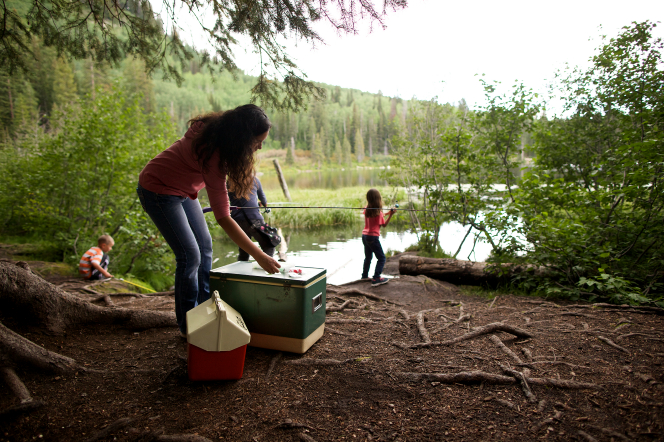
A mother prepares a fishing line by a cooler while the father and two children start to fish over at a lake.
The Family: A Proclamation to the World, states that successful families are built on (among other things) work and wholesome recreational activities. It seems impossible to ever get caught up around the house so that we can actually spend some time together relaxing as a family. But, I think that is exactly the point. It is precisely the things that require sacrifice, effort, and dedication that signal to our brains that something is important, worthwhile and worthy of our time and attention.

For many of us, it's difficult to imagine taking time away to do something fun with our families when we always feel the pressure that we are falling behind. Federal holidays are usually the big winners here because it's the most likely time that nobody has to be anywhere or do anything for someone outside our own homes. But doesn't our family need to do things together more than five times a year? Of course! Also, let's be honest, we've all made Labor Day a federal "clean the garage day" before, am I right?

Naturally, we don't need to plan an entire day, weekend or even a two-week vacation in order to spend time together. But, we should absolutely take the trouble to intentionally do things together as families on a regular basis. Think of the memories you have of spending time with your family as a child. While the big events like Thanksgiving and Christmas often blur together, we remember very clearly that time we went camping and it rained all night while we stayed up and told stories. We remember going to the ocean and rolling down the sand dunes like a log. We remember visiting our cousins and getting sunburned because we played out on the trampoline too long. It may seem frivolous or even unwise to drop all the responsibilities of home to go play with our families. But, as I've gotten older, I've realized that I spent way too much time worrying about what my house looked like and how far behind I was, and not nearly enough time leaving it to go play with my kids.

Women are just as susceptible to falling victim to the old adage, that no one ever laid on their death bed wishing they had spent more time at work. If you wait until you're "caught up" before you plan family time, you will never have family time. Leave the laundry and go play!

How do you recreate as a family? How have you taught your children the value of work? Share your experiences if you have overcome the perfectionist tendency to do all the work yourself or to neglect fun for all the busyness around you.


Hawkins, A., Dollahite, D., & Draper, T. (2012). Successful Marriages and Families: Proclamation                  Principles and Research Perspectives. Provo, Utah: BYU Studies.


Tuesday, December 3, 2019

Prayer and Forgiveness in Marriage


As members of the Church of Jesus Christ of Latter-Day Saints, we are commanded to pray. We are to pray in the morning, in the evening, alone in our closets, in our "fields" (work?), in our families, in our marriages, in the temple, in church, before we read our scriptures, to begin and end meetings, pray for our enemies, and keep a prayer in our hearts always. Even a song in Christ's name is a prayer unto Him. Whew! That's a lot of praying! The only prayer that seems to come naturally for my family is praying over the food, which I don't know was ever officially commanded. But hey, whatever gets us praying! 

I remember kneeling across the altar from my soon to be husband and having the sealer counsel us to pray as a couple every day. This, I understand, is a pretty common counsel given to newlyweds. Why? Because the trials are coming and God is the glue that holds the marriage together when we become weary and weak. 

Prayer does a number of things for a marriage. First and foremost, it sanctifies your union and allows God to bless and preserve it. It creates a sense of holiness within the individuals in that union that has been shown to reduce infidelity and divorce. Second, it helps to bind a couple to cooperative goals and keeps them working together down the same path with guidance and inspiration from GodFinally, it promotes humility and facilitates forgiveness and healing.

In all the praying you're doing, don't neglect daily couple prayer. Prayer creates a healthy and vital relationship with protective and curative properties. It's your marital leafy greens!


A woman sitting at a kitchen counter looking sad and her husband leaning over with an arm around her.

Now that we've sung the praises of the wonderful blessings of couple prayer, let's switch gears and address the hard stuff. 

There will be times when your spouse is insensitive, selfish, hurtful or just plain mean. How do you know this will happen? Because, sometimes you're insensitive, selfish, hurtful and mean, and you're a good person! Still, you know you should shake it off and go have your nightly couple prayer, but you just don't feel like bonding with that so-and-so, who is mumbling some nonsense about it being all your fault, in the other room.

Well, far be it from me to assume I know what's going on with you two crazy kids, but here are some useful steps to help you move through the emotions so you can get to a place of forgiveness according to science. 

Step 1. Recall the hurt. O.k., I know this seems like a strange way to start. But, some people really do skip this. In a misguided attempt to be Christ-like, or to avoid the pain or embarrassment of acknowledging wrongdoing, some people will default to brushing off a painful incident as though there was no offense. This is extremely unhealthy and doesn't honor your self-worth. In order to forgive, you have to acknowledge that something inappropriate happened.

Step 2. Empathize. This step is not to be confused with making excuses for the wrongdoer. This is a common mistake for those who like to skip Step 1. Excuses promote abuses. (Yep, I made that up just now. Too bad memes don't pay). So, in other words, making excuses is saying, it's ok that you did the wrong thing because you had a good reason. Empathy, on the other hand, is simply saying I understand why you hurt me.

To properly empathize, we try to understand and feel the wrongdoer's feelings and reasonings. We try to understand where they are coming from and whether the wrongdoing was intentional or as egregious in their minds as it is in ours. We attempt to get on the same page about the intention and inappropriateness of what occurred.

Step 3. Offer the altruistic gift of forgiveness. This selfless act releases you and your offender from any obligation to rehash the offense. It is given out of love and caring for the other (or the Savior, if that's all you've got right now) with the benefit of allowing you the space to move on and heal.

Step 4. Commit publically to forgive. While this seems extreme in the case of a little lover's quarrel, it's highly useful in more damaging acts of victimization, so I've included it as a point of interest. Still, it can be useful in the healing process if done semi-publically. Committing to your spouse that you have forgiven the offense may be enough. However, a stronger commitment may come by telling a therapist or bishop. You may even find a little private resolution by writing your commitment in your journal or in a letter you never intend to send. Do whatever seems appropriate to the situation.

Step 5. Hold on to forgiveness. Forgiveness doesn't always replace the pain of being wronged. The memories and trauma of an injury can resurface from time to time. It's good to remember that just because you haven't forgotten the pain, doesn't mean you didn't really forgive. This goes for repentance as well. Use the memories of the experience as an opportunity to reinforce the fact that you have already forgiven and let the incident go. This will give you strength when you will likely need to forgive again.

Image result for lds couple forgiveness

The next obvious question is, what do you do when your spouse is a repeat offender? The honest answer is. . . I don't know. I'm only a sophomore and we haven't covered that yet. But, I suppose you should have lots of conversations with "I statements". For example, 'I feel unimportant to you when you don't. . .', or 'I felt stupid when you mentioned. . . to my family', and so on.

I do think clear boundaries are important. You can't even attempt step one of the forgiveness process until you know what boundary was crossed. Maybe that's another reason some people skip step one. They don't even know what their boundaries are. Clear boundaries and expectations allow others to know the best ways to show their love for you. Give them this gift.

Speaking of gifts. . .

As the semester comes to a close, my thoughts are turned to the upcoming Christmas season! I hope that in all of your fabulous family festivities you set some time aside to nurture the most important relationship in your life.


What are some definite boundaries for you? What boundaries are regularly being crossed because, now that you think about it, you've never said, "Hey, that's a boundary. Don't cross it."? 

Has couple prayer blessed your marriage in some magnificent way that you'd love to share?

Also, if you have any brilliant ideas about repeat offenders, I'd love to hear those too! 
(I have teenagers.)

Hawkins, A., Dollahite, D., & Draper, T. (2012). Successful Marriages and Families: 
                Proclamation Principles and Research Perspectives. Provo, Utah: BYU Studies.


Monday, December 2, 2019

Beware the green painted grass


The old saying, "The grass is always greener on the other side of the fence" implies that what others' have appears to be better than what you have. In terms of marriage, this may mean that someone may think that they could have been happy if only they had married someone else.

So, let's talk lawns, metaphorically. In order to sell a house, some people literally spray paint their lawn green to make the house appear more attractive. The lawn could also be entirely fake synthetic grass, like what's used on football fields. But, in fairness, the lawn could also very well be greener.

What does all this turf talk have to do with marriage? Well, let's consider the painted grass. This could represent a false image that others are having an easier time in marriage than you are having. Fake grass may represent someone you are attracted to who doesn't seem to have major flaws like spouses you know. Since you don't really know what is going on behind closed doors and you don't really know what a person is like if you haven't lived with him/her for a few years, you shouldn't allow yourself to be fooled by fake or painted grass.

But, what if the grass really is greener? Think for a moment what that means. It means that the homeowners know a little something about growing green grass. They've learned about it, worked at it, pulled the weeds, aerated and fertilized when needed. Who knows, they may even have hired a professional from time to time. The point is, all grass has the potential for greenness if both parties learn a little something about grass and work hard to make it that way. If you don't learn how to tend grass, you're just going to destroy grass everywhere you go.


In my own marriage, my husband and I took the typical route. We went through the standard stages I discussed in a previous post, "Successful marriages don't just happen". We basked in the glory days of honeymoon-ism, stumbled through the "What was I thinking?" phase, and now after 21 years, we've finally reached marital bliss. We no longer have loud arguments, or disagree about anything really. We've learned to always be respectful of one another and listen intently with empathy and understanding. We've tackled every major obstacle together, and those obstacles have always brought us closer together. We've found our groove and life is good every single day.  Also, this is total baloney! You bought it though, didn't you? Well, it's tempting to hope for a time when marriage is easy and friction-free, and maybe we'll get to glimpse something like it before we die. But, I'm not holding my breath. The point is, it takes a lot of time and work to create marriages that bring real lasting joy. But, don't fool yourself into thinking that lasting joy is completely free of irritations. Lasting joy means deep love, loyalty, and commitment despite the irritations. Like my grandpa used to say, "If a married couple ain't arguing, somebody's takin' a lot of crap off someone else." I think what he meant was that if a couple seems content all the time, someone is probably getting walked on, therefore it's not a measure of marital success.


Look, deciding to stick it out and accept that there are some things that just won't change in this life-time takes a tremendous leap of faith. As a married couple, your job is not to fix the things about your spouse that bother you. While some fixing may be necessary, it's really about fine-tuning your patience and deepening your love and admiration for the good things about your beloved so that the little irritations become irrelevant to how you feel about him/her.

Marriage can be a grand journey with many lovely vistas and interesting side roads if your perspective is right. But, how can you appreciate a sunset on the summit if you won't stop dwelling on the mud in the ravine? (Sometimes I think I should write Hallmark greeting cards).

I know that there are times when ending a marriage is necessary. This isn't what I'm talking about. I'm saying that too often it's not as necessary as it seems. When family, friends and even marriage therapists are telling you to walk away, they are often just trying to end their pain, not yours. They care about you and want you to be happy right now. But, the statistics are overwhelmingly conclusive. The chance that you will be happier if you stick it out through the tough times is manyfold more than if you call it quits.

I can't begin to imagine my life if I had ended my marriage when things got tough, and boy were there some tough times. If you are wondering if it will ever get better, stop wondering and do something about it. Do whatever it takes to learn how to care for your marriage. Read books, take classes, pray like you've never prayed before, forgive like you've never forgiven before, apologize like you have never apologized before. I promise it's worth every effort, every penny spent, every other opportunity missed. Make your marriage your top priority and your marriage will carry you through all the others.

Our lawn still has some brown spots; literally and metaphorically. At least metaphorically, the brown spots are becoming fewer and fewer as dedicated work on them is lovingly maintained. We are climbing the vistas together and the view is magnificent!

How do you keep your marriage a priority? What is it that makes your marriage special or especially resilient? What have you learned that has changed the direction of your struggling marriage? 


Hawkins, A., Dollahite, D., & Draper, T. (2012). Successful Marriages and Families: Proclamation                  Principles and Research Perspectives. Provo, Utah: BYU Studies.


Saturday, November 9, 2019

Mom, Dad, We Need To Talk


Well, I'm just going to say it. Men and women are different. We are anatomically, biologically, emotionally, socially, intellectually and spiritually different. And do you know what? That's a good thing. No, it's a great thing! I know it's not very popular in modern first world countries to acknowledge that women are better at some things and men are better at others, especially in regards to parenting. Equality has been made synonymous with sameness but it's just not, and I am so glad it isn't!


In studies conducted with parents of both genders, scientists have routinely found that the natural nurturer is unequivocally the mother. While fathers can also be nurturing, women are very different in their complex and subtle abilities to tune into their children. Neuropsychologists have discovered that mothers have a unique gift when it comes to their ability to help a developing baby's brain. Mothers are like skilled piano tuners who can hear subtle changes without the assistance of a tuning instrument. Mothers can literally sense minute changes in their child's emotions and needs and make nearly imperceptible adjustments to their interactions. The mother's endowment allows for the healthy cognitive and emotional development of children.

In my family, I can see this nearly every day. While my husband is a very loving man, he does not have the endowment of being as finely tuned into our children's needs in the same way that I am. Does this make me better than him? Not at all.

Here's where we take a moment to honor the dads. Yay, dads!

While scientists have found mothers to be nurtures and caretakers extraordinaire, they have found that the role of fathers is just as crucial to a child's healthy development. Here's some scientific evidence that fathers need applauding too. Good dads have preschool-aged children who have more empathy, self-control and yep, they're smarter. When dads are actively involved with their older kids, these kids act out less and are more emotionally stable. They are also more social and have fewer problems at school.

Fathers interact with their children differently than mothers and help children develop different parts of their brains. Through play like "roughhousing" children learn limits, respect, quick thinking and problem-solving. They also learn trust. This makes for some pretty decent kid qualities, not to mention translating into adulting later on.

All of these factors played out one day when my son was very young. He was probably only a couple years old and my husband was still a pretty new dad. They were roughhousing and playing together and having a great time. I saw a small problem though, my husband always "won". This meant my son always ended up tied up in knots or pinned down to the floor. The play was good for both of them but my mothering instincts were acutely tuned into how my son was feeling. I told my husband, you know, if you don't let him win once in a while, he'll get frustrated and won't enjoy playing with you anymore. At that moment, my son was benefitting from having two parents, equally yoked with different roles. He got the mental stimulation, as well as the understanding he needed, to have a perfectly balanced fun-filled growing experience.


A word of caution. The world has beaten women down for wanting to stay home and raise their children well. It has also sent a message to men that they are useless at home and fathering is irrelevant. Both messages are intended to minimize the importance of raising children and emphasize the glamour and allure of finding fulfillment somewhere other than your sacred home. This, you likely know. However, I would encourage each husband and wife to be intentional in honoring and building up your spouses in your sacred roles, because the world will not do it.

Men: never say things, or allow your wives to say things, like "stay at home moms don't work". It's degrading and just plain wrong. Never come home and look disappointed at an unkempt house or a late meal. Child-rearing is exhausting and emotionally taxing. Homemaking is secondary to well-tended children and an emotionally stable wife. And, I promise she has already beaten herself up about her failings. She doesn't need your help in that area. Never make her feel that you don't value what she does even if she doesn't do it as well as your mom did. Never make her feel that the money you earn is of more worth than what she is creating. If you don't value the sacrifices she made with her body, her time and her self esteem in a cruel world who only cares if she looks young and fit, nobody will.

Women: support your husbands as fathers. Remind them how important they are to your children. Encourage and praise them for playing and working with their children. Appreciate the efforts they make to teach and guide your family. Boost their self-confidence to be the spiritual leaders they are called to be. Ask their opinions, get their advice, TAKE their advice, get blessings often, pray for them and pray with them. Many men are intimidated by the naturally spiritual nature of women and would prefer to delegate the spiritual leadership to them. Support their patriarchal call and give them opportunities to succeed.

How do you support your spouse in their divine role? Comment below and tell me how you build each other up to be the best parents you can be?

Hawkins, A., Dollahite, D., & Draper, T. (2012). Successful Marriages and Families: Proclamation 
                Principles and Research Perspectives. Provo, Utah: BYU Studies.


The Straight and Narrow Path After Entering the Gate

       I've long been fascinated with the concept of having one's calling and election made sure. It seemed to me to be a great way ...